What Is Robotic Surgery?
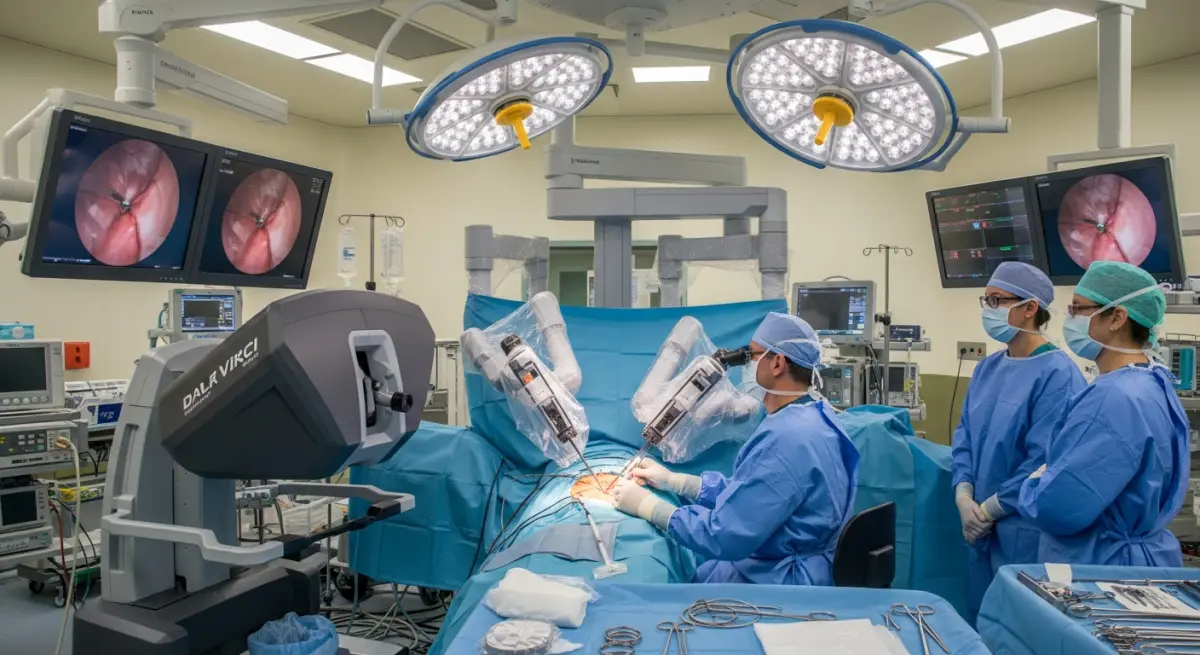
Robotic surgery is a form of minimally invasive surgery in which a surgeon controls a set of robotic arms — equipped with miniaturized surgical instruments and a high-definition 3D camera — from a console located a few feet from the operating table. The robotic system translates the surgeon's natural hand, wrist, and finger movements into precise, scaled motions of the instruments inside the patient's body. This translation includes tremor filtration (eliminating the natural hand tremor that affects all surgeons), motion scaling (converting large hand movements into tiny instrument movements for maximum precision), and a camera magnification system that gives the surgeon a three-dimensional, magnified view of the surgical field far superior to what the naked eye or a standard laparoscope provides.
The da Vinci Surgical System — manufactured by Intuitive Surgical and the market-leading platform globally — is the most widely used robotic system, with over 6,000 installations in hospitals across 70 countries. Its Xi and SP (single port) models represent the current generation, offering wristed instrument movements with seven degrees of freedom, 10× magnification, and full HD 3D visualization. Other notable systems include the ROSA robotic system (used for knee and hip replacement, and neurosurgery), the Mako SmartRobotics system (orthopedic joint replacement), the Versius system (soft tissue surgery), and the Hugo RAS system (general and gynecologic surgery). Each system is designed for specific surgical domains where their particular mechanical design offers the greatest advantage.
The international spread of robotic surgery has been one of the most significant developments in medical tourism. Leading hospitals in Turkey, India, South Korea, and Germany have invested heavily in da Vinci and other robotic platforms to attract international patients who prioritize minimally invasive approaches. Acıbadem Maslak Hospital in Istanbul operates multiple da Vinci Xi systems and performs hundreds of robotic procedures annually across urology, gynecology, thoracic surgery, and colorectal surgery. The hospital's robotic surgery program trains surgeons from across the Middle East and Eastern Europe, reflecting a level of expertise that drives robotic surgical volume and outcome quality.
Key Procedures: When Robotic Excels
Robotic prostatectomy (da Vinci radical prostatectomy) is the procedure that established robotic surgery's clinical reputation and remains its most performed application globally. For localized prostate cancer requiring surgical treatment, robotic prostatectomy achieves equivalent cancer control to open surgery while dramatically improving the preservation of urinary continence and erectile function — the two major functional concerns after prostate cancer surgery. The robotic system's precision in the narrow confines of the male pelvis, combined with the surgeon's enhanced visualization of the neurovascular bundles responsible for erectile function, makes nerve sparing technically easier and more complete than in open surgery.
Robotic hysterectomy for fibroids, endometriosis, and gynecologic cancers delivers a 3–4 day shorter hospital stay than open hysterectomy, with less blood loss (no transfusion in over 90% of cases), lower infection rates, and return to normal activity at 2–3 weeks versus 6–8 weeks for open surgery. Robotic colorectal surgery is particularly valuable in rectal cancer resection, where the anatomy of the narrow male pelvis makes standard laparoscopy technically challenging — robotic instruments' wrist articulation provides access angles that standard laparoscopic instruments cannot achieve. Robotic partial nephrectomy (kidney cancer surgery preserving the healthy kidney tissue) is associated with lower warm ischemia time and higher rates of complete tumor removal compared to laparoscopic partial nephrectomy.
In orthopedics, the Mako robotic system for knee and hip replacement uses CT-based 3D modeling of the patient's specific anatomy to create a personalized surgical plan, then provides real-time haptic feedback to the surgeon during implant positioning — keeping the saw and implants within the planned boundaries to achieve precision that manual techniques cannot replicate. Studies show Mako-assisted total knee replacement achieves better implant alignment and positioning accuracy, which correlates with improved long-term implant survival and patient-reported functional outcomes. Asan Medical Center in Seoul has integrated Mako robotic technology into its high-volume joint replacement program, offering internationally accredited robotic orthopedic care.
Cost Comparison by Country
Robotic Surgery Cost Comparison 2025 (Key Procedures)
| Procedure | Turkey/India | South Korea/Germany | USA |
|---|---|---|---|
| Robotic Prostatectomy | $12,000 – $22,000 | $22,000 – $40,000 | $55,000 – $90,000 |
| Robotic Partial Nephrectomy | $10,000 – $18,000 | $18,000 – $32,000 | $40,000 – $70,000 |
| Robotic Colorectal Resection | $12,000 – $22,000 | $22,000 – $40,000 | $55,000 – $90,000 |
| Robotic Hysterectomy | $8,000 – $15,000 | $15,000 – $28,000 | $35,000 – $60,000 |
| Robotic Knee Replacement (MAKO) | $12,000 – $20,000 | $18,000 – $35,000 | $40,000 – $65,000 |
| Robotic Cardiac Surgery (CABG) | $25,000 – $40,000 | $40,000 – $70,000 | $90,000 – $150,000 |
Prices are all-inclusive packages including hospital stay, anesthesia, implants (where applicable), and standard post-operative care. Robotic procedures typically require 1–3 night hospital stay versus 5–7 nights for open surgery equivalents.
Turkey stands out as the most cost-effective destination for robotic surgery in Europe and the Middle East, with Istanbul's internationally accredited hospital groups offering da Vinci robotic procedures at 55–70% below US pricing. Acıbadem Healthcare Group and Memorial Hospital Group — both operating multiple hospitals in Turkey — have invested in comprehensive robotic surgery programs covering urology, gynecology, thoracic, cardiac, and colorectal specialties. These hospital groups operate at sufficient volume to maintain dedicated robotic surgery training programs and achieve the surgical experience levels that deliver consistently excellent outcomes.
South Korea is widely considered the Asian leader in robotic surgery adoption and expertise, with Samsung Medical Center, Asan Medical Center, and Seoul National University Hospital performing some of the world's highest volumes of robotic procedures across all specialties. Korean surgeons have been early adopters of new robotic platforms and frequently author publications in international journals documenting outcomes from robotic techniques. For patients seeking robotic surgery combined with the most advanced technology available, South Korea represents a premium but still significantly more affordable option than the United States.
Choosing Your Robotic Surgeon
The robotic system is a tool — the outcome depends on the surgeon's skill, judgment, and experience with the specific procedure, not simply whether the robot is available. Surgeon volume is the most critical quality indicator: a surgeon who has performed 500+ robotic prostatectomies has fundamentally different capability than one who has performed 50. This volume-outcome relationship is especially pronounced in complex procedures like robotic radical prostatectomy, where nerve-sparing precision and the ability to manage intraoperative complications are directly related to how many procedures the surgeon has personally performed. Ask for the surgeon's specific case log numbers and inquire about their complication rate and conversion rate (how often they must convert from robotic to open surgery due to technical difficulty or bleeding).
Surgeon training and credentialing also matters. Formal robotic surgery training programs — offered by Intuitive Surgical (for da Vinci) and available at major training centers — provide structured certification requirements. Many leading international robotic surgeons have completed fellowship training at high-volume robotic surgery programs in the US, UK, or continental Europe before returning to practice in their home countries. During your virtual consultation, ask about the surgeon's training background, where they completed their robotic surgery certification, and whether they are currently involved in teaching or training other surgeons (a strong indicator of recognized expertise).

Planning Your Surgery Trip
Robotic surgery for most procedures requires a 1–3 night hospital stay — dramatically shorter than open surgery equivalents. This shorter hospitalization means international patients can complete their entire medical trip — consultation, pre-operative tests, surgery, hospital stay, post-discharge recovery, and final wound check — within 7–10 days for most procedures. Planning includes: obtaining and sharing your imaging and medical records with the international surgical team, completing a virtual pre-operative consultation, arranging travel logistics (flights, hotel within easy distance of the hospital), coordinating post-operative supplies (compression garments, medications), and arranging a travel companion who can assist during the early recovery days.
Access world-class robotic surgery abroad at a fraction of US costs. Compare surgeons, systems, and programs with a free consultation.
Explore Robotic Surgery OptionsFrequently Asked Questions
Is robotic surgery always better than laparoscopic surgery?
Not for every procedure — robotic surgery offers the greatest advantage in anatomically challenging locations (deep pelvis, narrow spaces) and procedures requiring fine dissection near critical structures (neurovascular bundles in prostatectomy, sphincter preservation in rectal surgery). For straightforward laparoscopic procedures in accessible locations (cholecystectomy, appendectomy, hernia repair), standard laparoscopy achieves equivalent results at lower cost. The value of robotic surgery is procedure-specific and patient-specific, and an experienced minimally invasive surgeon should recommend the best approach for your individual anatomy and procedure.
Are robotic surgery results the same regardless of which hospital abroad?
No — results vary significantly based on surgeon volume, training, and the specific hospital's robotic surgery program quality. A hospital that performs 20 robotic prostatectomies per year achieves different outcomes than one performing 200. Always inquire about surgeon-specific case volumes, not just hospital volume. Leading international robotic surgery programs publish their outcomes data in international journals — ask if the program's outcomes are published and request access to this information.
What is recovery like after robotic surgery?
Robotic surgery recovery is dramatically faster than open surgery. Hospital stays of 1–3 nights are standard for most robotic procedures. Pain is significantly less than open equivalents, typically managed with oral analgesics from day 2. Return to light desk work occurs at 1–2 weeks; driving at 2–3 weeks; moderate physical activity at 3–4 weeks; full activity including exercise at 4–6 weeks. This accelerated recovery profile makes robotic surgery particularly well-suited for medical tourism, as patients can return home sooner after achieving surgical fitness for the journey.
Does robotic surgery leave scars?
Robotic surgery leaves 3–5 small incisions (typically 8–12mm) plus a slightly larger extraction incision (3–5cm) where removed tissue is retrieved. These incisions heal to small, virtually imperceptible scars within 6–12 months, particularly with silicone gel scar management. This is in dramatic contrast to the 15–30cm incision typical of open surgery for the same procedures. For cosmetically sensitive patients, the minimal scarring is one of the most appreciated benefits of robotic surgery.
How do I ensure continuity of care between my international surgeon and home physician?
Your international surgical team will provide comprehensive operative notes, pathology reports (within 5–7 days of surgery), and a detailed post-operative care plan written for your local physician. Most international hospitals offer email and video follow-up with the treating surgeon for 3–6 months post-surgery. Provide your local physician with all documentation before your first home follow-up appointment. For oncological procedures requiring adjuvant therapy after surgery, the surgical team coordinates directly with your home oncologist regarding pathological findings and adjuvant recommendations.