Modern Ovarian Cancer Treatment
Ovarian cancer is the most lethal gynecologic malignancy, largely because most cases are diagnosed at advanced stage (Stage III or IV) when cancer has spread throughout the abdominal cavity. Despite this challenging presentation, modern treatment has significantly improved outcomes: 5-year survival for Stage III ovarian cancer has improved from 15–20% in the 1990s to 30–45% at specialized high-volume centers today, driven by improved surgical techniques achieving complete cytoreduction, more effective platinum-taxane chemotherapy regimens, antiangiogenic therapy with bevacizumab, and the introduction of PARP inhibitors as maintenance therapy for BRCA-mutated and HRD-positive tumors.
The most critical determinant of outcome in advanced ovarian cancer is surgical — the degree of tumor removed at primary debulking surgery. Complete cytoreduction (R0 resection — no visible residual disease) versus suboptimal debulking (>1cm residual disease) dramatically impacts survival: patients with R0 resection have 5-year survival rates 2–3 times higher than those with significant residual disease. This is why ovarian cancer surgery should be performed by specialized gynecologic oncologists at high-volume centers, not by general gynecologists or general surgeons. The volume-outcome relationship in ovarian cancer surgery is one of the strongest in all surgical oncology — centers performing 30+ ovarian cancer surgeries per year have significantly better R0 resection rates and survival outcomes than lower-volume practices.
At internationally accredited gynecologic oncology centers like University Hospital Zurich and University Hospital Cologne, ovarian cancer surgery is performed within a multidisciplinary framework that includes specialized peritoneal surgeons who can perform extensive bowel, urologic, and hepatobiliary resections to achieve complete cytoreduction when disease involves these structures — a level of surgical commitment not available at lower-volume centers. This comprehensive approach to cytoreduction is associated with the improved survival outcomes documented at specialized centers.

BRCA Testing & Genetic Profiling
BRCA1 and BRCA2 germline mutations are present in 15–20% of ovarian cancer patients and have profound implications for both treatment and family genetic counseling. BRCA-mutated tumors have exquisite sensitivity to PARP inhibitors — olaparib (Lynparza), niraparib (Zejula), rucaparib (Rubraca) — which maintain tumor response as maintenance therapy after platinum-based chemotherapy and dramatically extend progression-free survival. The approval of first-line olaparib maintenance for BRCA-mutated ovarian cancer (SOLO-1 trial showing 56% progression-free survival at 5 years versus 13% for chemotherapy alone) represents one of the most dramatic therapeutic advances in gynecologic oncology.
Beyond germline BRCA testing, somatic tumor testing and homologous recombination deficiency (HRD) testing expand the population eligible for PARP inhibitor benefit. Tumors with HRD-positive signatures — whether BRCA-mutated or not — respond to PARP inhibitors. Comprehensive genomic profiling using NGS also identifies other actionable alterations and provides tumor mutational burden (TMB) and microsatellite instability (MSI) status relevant to immunotherapy eligibility. Patients who have not received comprehensive molecular tumor profiling should request it at their international consultation, as these results fundamentally inform treatment strategy and maintenance therapy options.
Cytoreductive Surgery & HIPEC
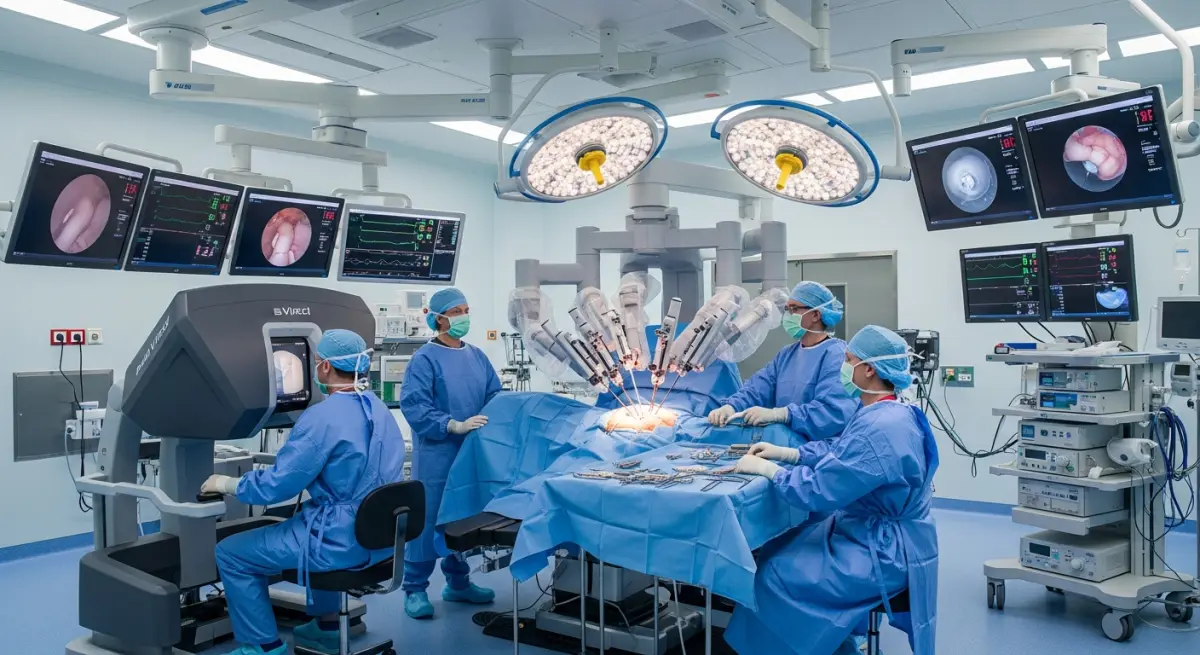
Primary debulking surgery (PDS) for advanced ovarian cancer involves removal of the uterus, both ovaries and tubes, omentum, and all visible peritoneal tumor deposits. At specialized centers, this may extend to bowel resection, bladder peritoneum stripping, diaphragm stripping, liver capsule resection, and splenectomy to achieve complete cytoreduction. The procedure takes 3–8 hours depending on extent. In patients with very high tumor burden where complete cytoreduction is unlikely at initial surgery, neoadjuvant chemotherapy (3 cycles of carboplatin/paclitaxel) followed by interval debulking surgery (IDS) achieves equivalent outcomes in appropriately selected patients while reducing the surgical complexity and morbidity of the initial operation.
HIPEC at interval debulking is supported by the OVHIPEC randomized trial, which demonstrated improved overall survival (45.7 vs 33.9 months) when HIPEC was added to IDS for Stage III ovarian cancer. Despite this evidence, HIPEC for ovarian cancer is not universally available or accepted, and its role continues to be refined. High-volume centers that have integrated HIPEC into their ovarian cancer treatment pathway — including those in Germany, the Netherlands (Amsterdam UMC), and major Indian cancer centers — offer this treatment to appropriately selected patients within experienced multidisciplinary programs.
Cost Comparison by Country
Ovarian Cancer Treatment Cost Comparison 2025
| Treatment | Turkey/India | South Korea/Germany | USA |
|---|---|---|---|
| Primary Cytoreductive Surgery | $15,000 – $28,000 | $28,000 – $50,000 | $60,000 – $100,000 |
| HIPEC + CRS | $20,000 – $35,000 | $35,000 – $60,000 | $80,000 – $130,000 |
| Carboplatin/Paclitaxel (cycle) | $1,500 – $3,500 | $3,500 – $6,500 | $8,000 – $15,000 |
| Bevacizumab Maintenance (cycle) | $2,000 – $4,000 | $4,000 – $7,500 | $12,000 – $20,000 |
| PARP Inhibitor (monthly) | $2,000 – $4,500 | $4,500 – $8,000 | $15,000 – $22,000 |
| BRCA + NGS Tumor Testing | $800 – $1,500 | $1,200 – $2,500 | $3,000 – $6,000 |
Prices reflect the first line of treatment. Recurrent disease management costs vary widely based on regimen. PARP inhibitor savings abroad are among the most dramatic in all oncology.
The most dramatic cost savings in ovarian cancer treatment come from PARP inhibitor maintenance therapy — where $15,000–$22,000 monthly costs in the US compare to $2,000–$4,500 in Turkey and India. For patients requiring 2–3 years of maintenance therapy, this difference represents $300,000–$700,000 over the treatment course. Many patients choose to receive surgery and initial chemotherapy in their home country and then transition to international procurement of maintenance therapy medications under medical supervision. India in particular has generic versions of olaparib and niraparib available at 5–20% of US brand pricing through licensed generic manufacturers.
Managing Recurrent Ovarian Cancer
Ovarian cancer recurrence affects the majority of advanced-stage patients, typically within 2–3 years of initial treatment. Management of recurrent disease depends critically on the platinum-free interval (PFI) — time from last platinum chemotherapy to recurrence. Platinum-sensitive relapse (PFI >6 months) benefits from platinum re-treatment combined with bevacizumab and/or PARP inhibitor maintenance. Platinum-resistant relapse (PFI <6 months) requires non-platinum regimens — weekly paclitaxel, liposomal doxorubicin, topotecan — with bevacizumab. Secondary cytoreductive surgery (SCRS) benefits selected patients with isolated, resectable recurrent disease, and the DESKTOP III trial has defined criteria for identifying patients who benefit from SCRS.
Connect with specialized gynecologic oncology teams abroad. Get expert second opinion and treatment planning for ovarian cancer.
Get Ovarian Cancer ConsultationFrequently Asked Questions
How do I know if I need BRCA testing?
All women diagnosed with ovarian cancer (high-grade serous, clear cell, endometrioid, or mucinous histology) should receive germline BRCA1/2 testing regardless of age and family history — this is the current recommendation from all major oncology guidelines (ASCO, ESMO, SGO). If your treating physician has not ordered BRCA testing, request it proactively. Additionally, all ovarian cancer patients should have their tumor tested for homologous recombination deficiency (HRD) status, as HRD-positive patients without BRCA mutation also benefit from PARP inhibitors.
Should I seek surgery at a specialized gynecologic oncology center?
Yes — strongly. The evidence that surgical volume correlates with complete cytoreduction rates and overall survival in ovarian cancer is among the strongest in oncological surgery. Centers performing 30+ advanced ovarian cancer operations annually achieve complete cytoreduction (no residual disease) in 50–75% of appropriate candidates; low-volume centers achieve complete cytoreduction in only 15–35%. This difference in surgical quality translates directly into survival differences of 12–18 months or more. If your initial treating hospital is not a high-volume ovarian cancer surgery center, pursuing surgery at a specialized center is warranted.
What is the role of bevacizumab in ovarian cancer?
Bevacizumab (Avastin), an antiangiogenic monoclonal antibody that targets VEGF, is used in two settings for ovarian cancer: first-line therapy concurrent with and then as maintenance after platinum-taxane chemotherapy (GOG-218 and ICON7 trials show improved progression-free survival); and in recurrent platinum-sensitive and platinum-resistant disease. Bevacizumab does not improve overall survival in unselected ovarian cancer patients in first-line treatment, but does extend progression-free survival by 3–4 months. In high-risk patients (Stage IV, incomplete cytoreduction), it may provide greater benefit. At $12,000–$20,000 per cycle in the US versus $2,000–$4,000 abroad, the cost savings for bevacizumab maintenance are substantial.
How long does primary ovarian cancer surgery take and what is recovery like?
Primary debulking surgery for advanced ovarian cancer takes 4–8 hours depending on the extent of peritoneal disease and organ involvement. Hospital stay is typically 5–8 days for standard debulking and 7–14 days for extensive multivisceral resections. Recovery at home requires 4–6 weeks before most physical activities resume. For international patients, plan for 14–18 days in the treatment country: 2–3 days pre-operative evaluation, surgery day, 5–8 days hospital recovery, and 4–5 days hotel observation before being cleared for long-haul flight. A companion is essential for this procedure and recovery.
Is fertility preservation possible with ovarian cancer treatment?
Fertility preservation is possible in a highly selected subset of ovarian cancer patients — specifically young women with Stage IA/IB, Grade 1–2 epithelial ovarian cancer, or other favorable early-stage histologies (low-grade serous, borderline tumors). Fertility-sparing surgery (unilateral salpingo-oophorectomy preserving the uterus and contralateral ovary) can be offered to these carefully selected patients at specialized centers with experience in fertility-preserving gynecologic oncology. For most advanced-stage patients, fertility preservation is unfortunately not compatible with adequate surgical cytoreduction. Your gynecologic oncologist should discuss fertility implications before any surgery if this is relevant to your circumstances.